Stacking OpenSpec and Superpowers: A Combined SDD Workflow

This is a follow-up to From Vibe Coding to Spec-Driven Development. That post documented introducing OpenSpec into an existing Finance project. This one covers a new project where I stacked OpenSpec with Superpowers from day one.
After three months of running OpenSpec on my Finance project, I'd formed a clear picture of what it's good at and where it struggles. On a personal wiki project I'd also been using Superpowers, and its brainstorming, TDD, and code-review skills were landing real hits.
So I started a new project — a UTR-based tennis team lineup app (tennis-lineup) — specifically to run both tools together and see how they compose. This post is the report.
Where OpenSpec Alone Fell Short
OpenSpec is excellent at incremental change management. The propose → apply → archive loop keeps a clean spec library, and the archive step preserves delta specs as an audit trail. For shipping features one at a time on an existing codebase, it's hard to beat.
But over three months on the Finance project, four gaps became obvious:
- Project bootstrap is weak. OpenSpec drives changes well. On a brand-new project — where you need architecture, initial tech stack decisions, domain modeling —
opsx:proposehas nothing to anchor on. - Specs capture intent, not interaction. The spec tells AI what to build. UI details are often underspecified, and the first implementation rarely matches what I had in my head.
- Tasks list what, not how.
tasks.mdis a checkbox list. There's no implementation plan per task, so AI fills gaps on its own — sometimes fine, sometimes off-track. Tasks get silently skipped. - No test discipline. I pushed "tests first" into
config.yaml, but code quality was still inconsistent. Manual testing kept finding bugs a proper TDD cycle would have caught.
Where Superpowers Fills the Gaps
Superpowers is a collection of Claude Code skills. The three that matter most for SDD work:
superpowers:brainstorming— walks you through structured questions before writing any spec. Has a Visual Companion that generates HTML mockups you click through in the browser. Outputs a design spec at the end.superpowers:writing-plans+executing-plans— decomposes a spec into tasks, and each task into a red/green/refactor TDD sequence with exact file paths, commands, expected test output, and commit messages.superpowers:requesting-code-review— runs automatically after each task. Flags issues at CRITICAL / HIGH / MEDIUM / LOW levels with specific fixes.
OpenSpec covers change management and long-term spec accumulation. Superpowers covers upfront design, execution discipline, and review. They operate at different layers. They don't conflict — they stack.
The Combined SDLC
Here's the workflow I settled on for tennis-lineup:
Project init (once):
superpowers:brainstormingto pin down requirements and architecture. Outputs a design doc I commit todocs/.openspec init, then populateconfig.yaml— tech stack, conventions, test strategy (unit + integration + e2e) stated upfront.- Slice requirements by priority. Treat
docs/log/as a living journal; require every session to append to it viaCLAUDE.md.
Per feature:
- If the feature is fuzzy, start with
superpowers:brainstormingagain. Use Visual Companion for anything UI-heavy. The output is a design spec. - Run
opsx:proposewith that design spec as input. Getproposal.md,design.md, andtasks.md. - Run Superpowers TDD against those tasks. It writes tests first, implements, runs the suite, and runs code review per batch.
- Manual sanity check. Rework rate has been low.
opsx:applyto verify everything is ticked off — Superpowers usually already closed everything.- Deploy.
opsx:archiveto merge the delta spec back into the main spec library.- Scan the day's log — lift any new gotchas into
CLAUDE.mdandopenspec/config.yaml. Update the README. - Commit and push. Next feature.
The two tools hand off at clean boundaries: Superpowers designs and builds; OpenSpec tracks and archives.
One Feature End-to-End: Mobile UI Optimization
To show how this plays out in practice, here's a real feature from 2026-04-19.
The prompt:
/superpowers:brainstorming I want to use the UI mock capability to optimize
the UI for mobile:
  - sidebar should be hideable
  - when the right side has two columns (e.g., team management), hide the
    team list once a team is selected
  - two-column card layouts (e.g., saved lineups) should collapse to a
    single column on mobile
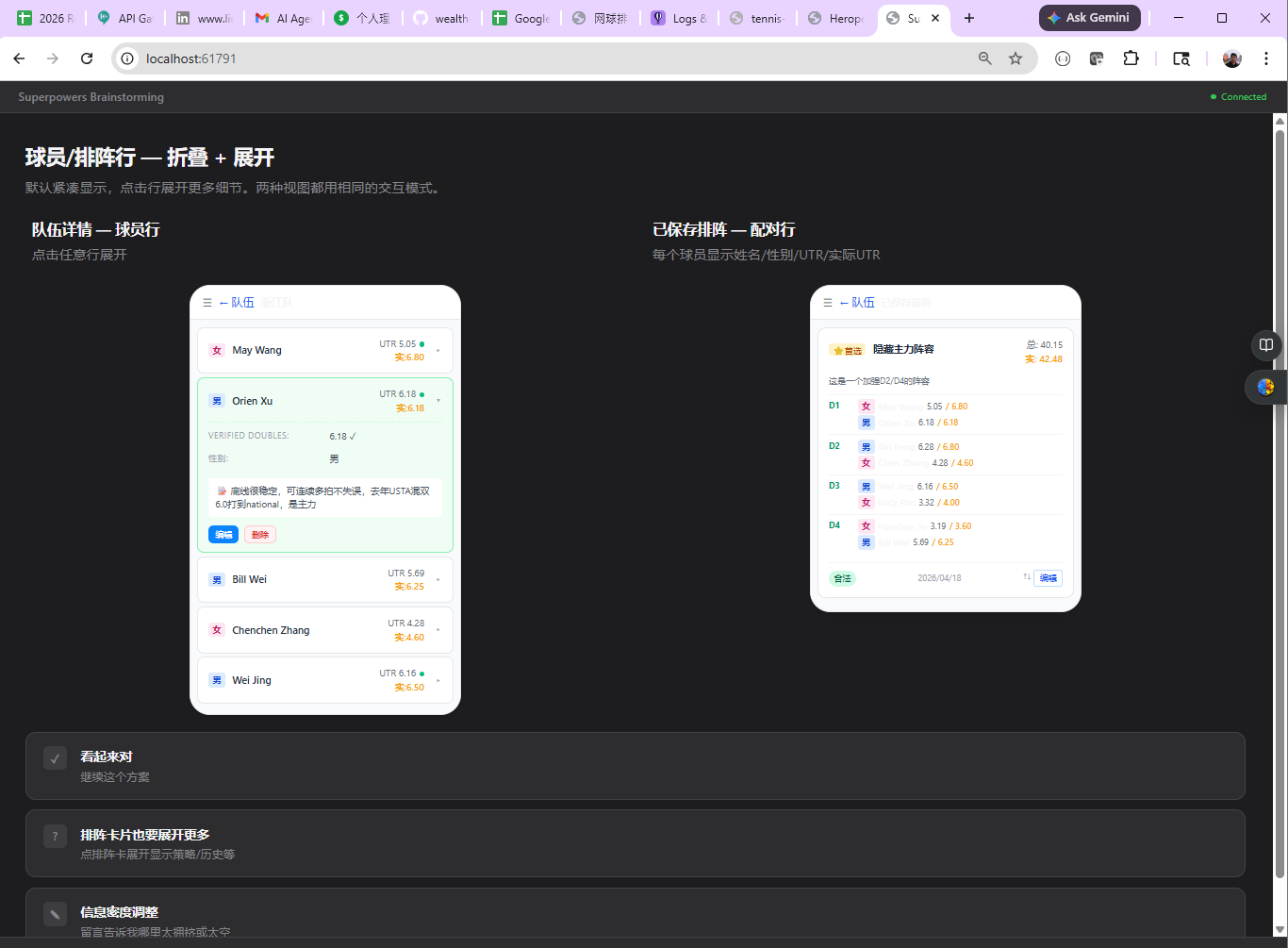
Step 1 — Brainstorming + Visual Companion. Superpowers generated HTML mockups I clicked through in the browser, then wrote a design spec.
Step 2 — Propose. opsx:propose took the design spec and produced an OpenSpec proposal and task list — 8 groups, 37 tasks.
Step 3 — TDD execution in batches. A representative batch result:
Batch 1 — Global shell (no backend changes)
Commit: 2e336bb

- New AppHeader.vue: hamburger menu + optional back button + title +
  actions slot; lg:hidden
- Refactored MainLayout.vue: provide('sidebarOpen', ref(false));
  Escape closes drawer
- Decision: SidebarDrawer.vue logic folded into MainLayout (no separate
  component needed)

Code review fixes:
  HIGH    inject fallback used a plain object (not a ref) — silently failed standalone
          → inject('sidebarOpen', ref(false))
  HIGH    hamburger aria-label was static "open nav" regardless of state
          → dynamic :aria-label + :aria-expanded
  HIGH    back button missing aria-label + type="button"
          → added, safe inside forms
  HIGH    removing pt-14 from MainLayout caused content to hide behind fixed header
          → restored pt-14 lg:pt-0
  MEDIUM  drawer had no Escape-to-close (WCAG 2.1.2)
          → global keydown listener in MainLayout
  LOW     missing overflow-x-hidden could flash horizontal scroll
          → added

Tests: 381 passing (16 new AppHeader tests)
This is the Superpowers loop working as designed: write test → implement → run → review → fix findings → commit. Every batch ended green.
Step 4 — One honest mistake. On the Opponent Analysis component, the UI mock only showed the mobile layout and I approved it without re-reading the existing spec. Superpowers implemented against the mock and silently dropped existing desktop functionality.
Fix:
- Re-ran
superpowers:brainstormingwith the existing spec loaded, re-did the UI design. - Continued Superpowers TDD against the revised design.
Lesson went into openspec/config.yaml so the next change won't repeat it.
Step 5 — Deploy, archive, update docs. opsx:archive synced the delta spec back. CLAUDE.md got updates for E2E dual-render pitfalls, SOCKS5 proxy setup, and Windows localhost dual-stack. config.yaml got dual-render data-testid, backend restart rules, TOCTOU, deploy smoke tests, and "sync before archive."
Full detail in the 2026-04-19 log.
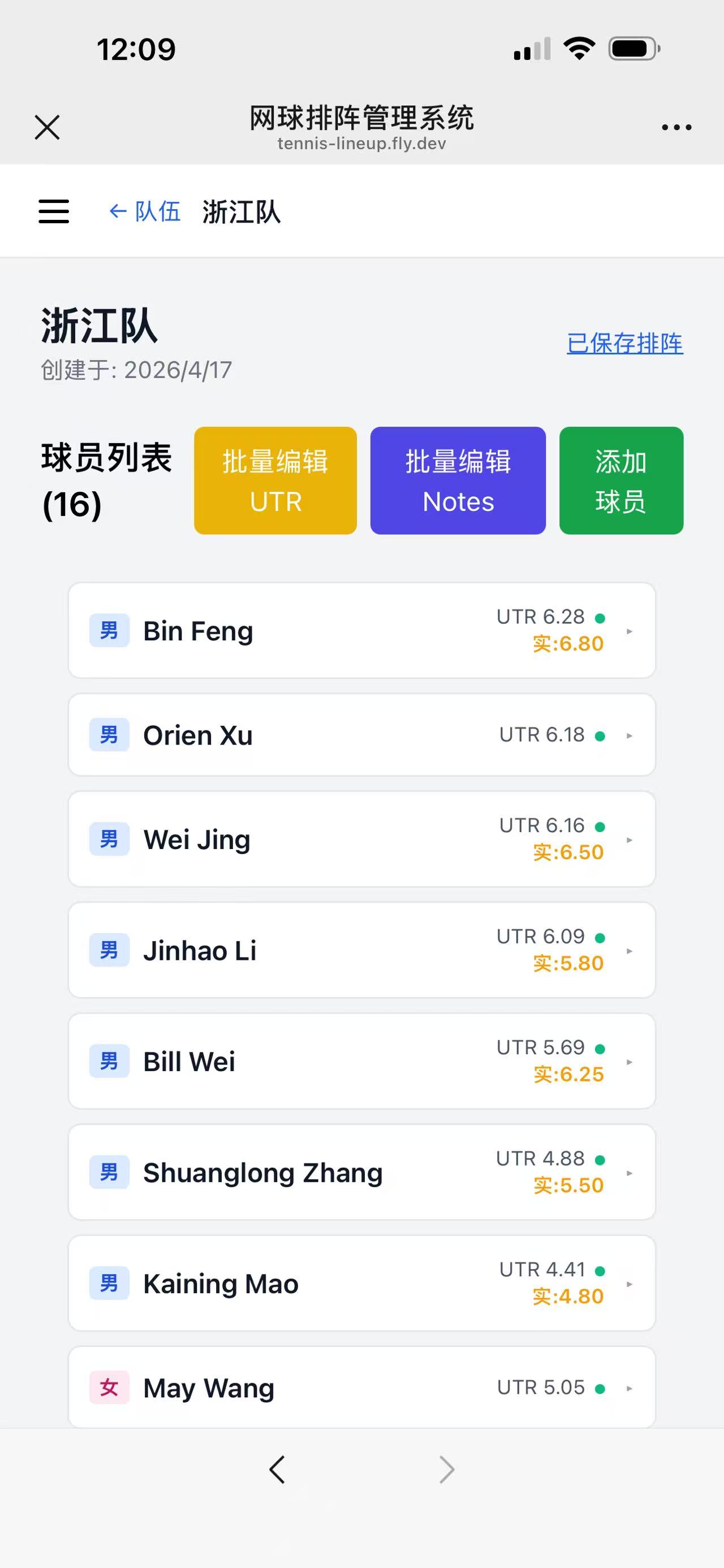
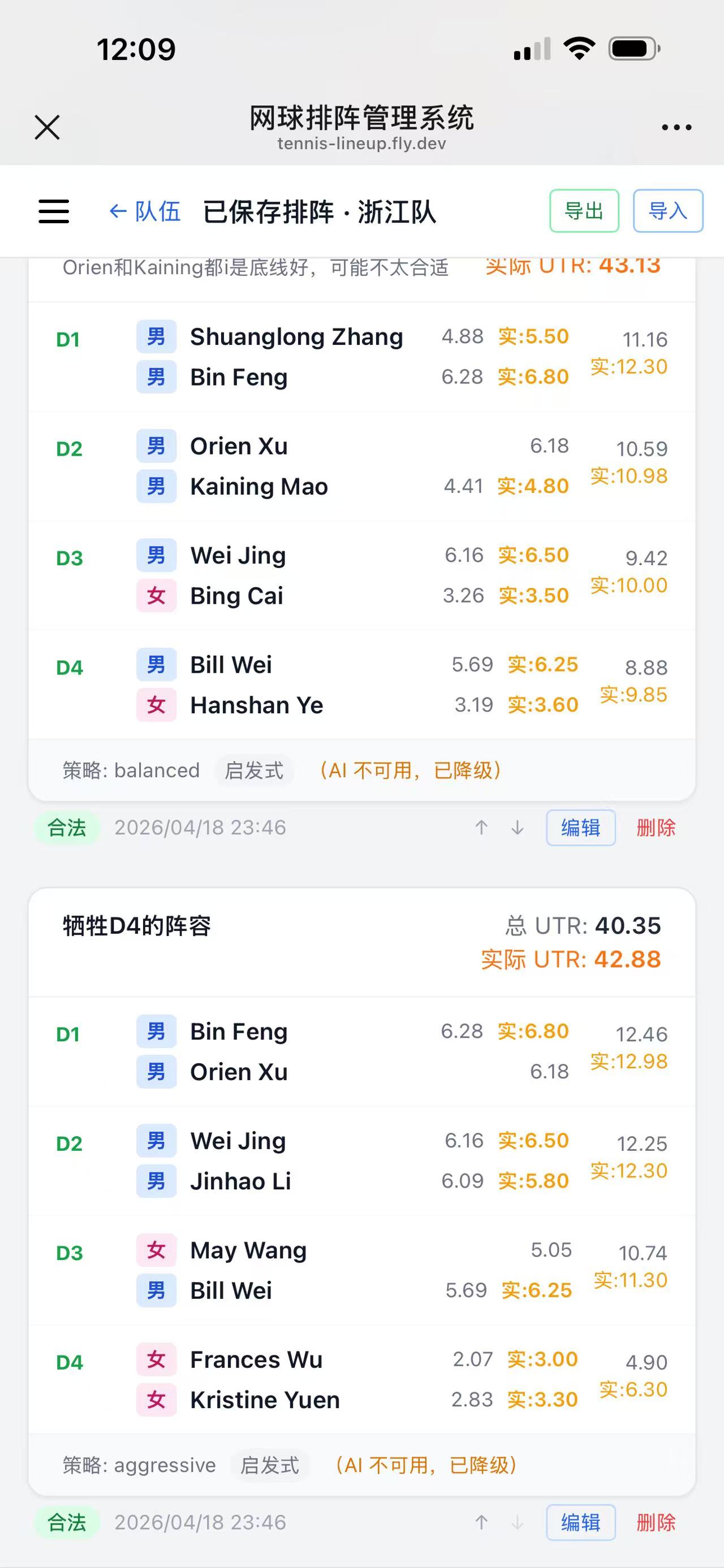
Result:
The Numbers
Window: 5c612fe (design spec) to ee4c3bd (archive) — 3 hours 7 minutes, including brainstorming, 6 implementation batches, one rollback + rework, E2E fixes, deploy, and archive.
Code delta (git diff 3f75465..ee4c3bd):
| Category | Files | +/− | Net |
|---|---|---|---|
| Vue source | 8 | +741 / −297 | +444 |
| Tests (unit + E2E) | 11 | +1094 / −16 | +1078 |
| Docs / specs / config | 22 | +2547 / −10 | +2537 |
| Brainstorming mockups | 19 | +4348 / −0 | +4348 |
| Total | 60 | +8730 / −323 | +8407 |
Tests added:
- Unit: +77 (365 → 442)
- E2E: +9 (44 → 53)
- Total: +86 test cases
Timeline:
| Time | Event |
|---|---|
| 09:00–09:23 | Brainstorming + design spec + implementation plan |
| 09:23–09:39 | Batch 1: AppHeader + MainLayout (+16 tests) |
| 09:39–09:54 | Batch 2: TeamManagerView + TeamDetail (+20 tests) |
| 09:54–10:00 | Batch 3: LineupCard (+12 tests) |
| 10:00–10:15 | Batch 4: LineupHistoryView (+9 tests) |
| 10:15–10:36 | Batch 5: LineupGenerator (+3 tests) |
| 10:36–10:49 | Batch 6: OpponentAnalysis rewrite (+46) — rejected by user |
| 10:49–10:50 | Revert + minimal mobile adaptation |
| 11:46 | Batch 13: OpponentAnalysis redesign TDD (+15 tests) + E2E fixes |
| 12:07 | Deploy to fly.io + archive |
ROI observations:
- 444 net source lines produced 86 test cases (test-to-code ratio ≈ 2.4:1 by line count).
- Biggest time sink was Batch 6 — the over-refactor and revert. Lesson cemented in
config.yaml. - 20 minutes of HTML mockups up front bought 2 hours of zero-rework implementation.
tasks.md vs plan.md: What Each Is Good For
OpenSpec's tasks.md and Superpowers' plan.md are not the same artifact. They operate at different granularities and for different readers.
| Dimension | OpenSpec tasks.md | Superpowers plan.md |
|---|---|---|
| Length | ~60 lines | ~1300 lines |
| Granularity | 8 groups × 37 tasks, one sentence each | 11 Tasks × 4–9 Steps each (write test / run / implement / verify / commit) |
| Code blocks | ❌ | ✅ Full Vue templates, JS, test cases |
| File paths | Component names only | ✅ Exact paths (frontend/src/components/AppHeader.vue) |
| Commands | mvn test / npm test | ✅ Precise commands + expected output (Expected: FAIL — ...) |
| Testing | "add/update tests" | ✅ Runnable TDD red-green-refactor |
| Commits | One per group (~8 commits) | ✅ Exact commit message per Task (~11+ commits) |
| Self-check | Spec scenario → task mapping is implicit | ✅ Spec coverage checklist at the end |
| Risk notes | In design.md | ✅ Inline (e.g., "Task 8.7 depends on backend") |
| Reader assumption | Developer who knows the repo | Engineer with zero context can follow it cold |
When each wins:
tasks.md is good for:
- Fast scope review and checkbox tracking
- Confirming "is the feature done?" (
applyRequireslives here) - Cases where you or the AI already know the implementation details
plan.md is good for:
- Handing work to a fresh engineer or a subagent with no context
- Strict TDD — red / green / refactor made explicit at every step
- Small-granularity commits that are easy to
git bisect - Dispatching tasks to
superpowers:subagent-driven-development
How I actually use both: tasks.md is the scope contract with OpenSpec. plan.md is the execution script for Superpowers. They share the same spec as source of truth — they just serve different phases.
So Is OpenSpec Still Needed?
With Superpowers this capable, is there still a reason to run OpenSpec?
For me, yes — for three reasons.
- Small-step iteration discipline.
propose → apply → archiveis a hard rhythm. It forces each change to have explicit scope, acceptance, and an archive step. - Long-term spec library.
opsx:archivesyncs delta specs into a growingopenspec/specs/tree. Over months, this becomes the project's authoritative specification — similar to how I treat my LLM wiki as the core notebook. Superpowers' specs and plans live per-change; they don't accumulate a project-level view. - Cross-check on completeness. OpenSpec tasks and Superpowers plans can be diffed against each other. If the Superpowers run finished but an OpenSpec task is still open, something was missed.
Short version: OpenSpec owns the spec lifecycle. Superpowers owns the design-and-execute loop inside a change. The two together give me both long-term structure and per-change rigor.
Token Cost
This change used ~180M tokens — driven by Opus 4.7 plus Visual Companion (which generates and iterates on HTML mockups). I'm on the Claude Code Max plan, so the actual out-of-pocket cost is fixed. For the delivered output — 444 source lines, 86 tests, design-to-archive in 3 hours with near-zero rework — it's acceptable.
Key Takeaways
1. Start every new project with brainstorming, not proposing. OpenSpec can't bootstrap architecture from a one-liner. Superpowers' structured questioning can.
2. Use Visual Companion for any UI change. 20 minutes of clickable mockups prevents hours of mismatched implementation. This was the single highest-leverage tool in the workflow.
3. Let Superpowers enforce TDD. Let OpenSpec enforce archival. Don't expect either to do both well.
4. Every mistake goes into config.yaml. The Batch 6 over-refactor is now a prevention rule. This is the compounding advantage of SDD over Vibe Coding — mistakes turn into structure, not just git history.
5. Keep a per-day log. The docs/log/YYYY-MM-DD.md habit makes retrospectives cheap and fuels CLAUDE.md / config.yaml updates.
References
Project
- tennis-lineup on GitHub — full source, including
CLAUDE.md, OpenSpec config, and day logs - Mobile UI optimization change (archived)
- 2026-04-19 session log
Tools
- OpenSpec — lightweight SDD CLI
- Superpowers — Claude Code skills for brainstorming, TDD, and code review
Related
- From Vibe Coding to Spec-Driven Development — the prior SDD post this one builds on